STORIES, IDEAS, AND INSPIRATION
Choosing the Right Business Email: Self-Hosted, Google Workspace, or Zoho Mail?
19 Sep
2026
In today's fast-paced digital environment, messaging apps such as WhatsApp, Telegram, and Line may dominate everyday team conversations.
However, when it comes to Digital Operations (DigOps), email remains an irreplaceable backbone of business infrastructure.
Email is more than just a tool for sending and receiving messages; it serves as a digital identity, a single source of truth for legal documentation, and an automation engine for business systems such as transactional notifications and ERP/CRM integrations.
As one of the most widely used digital communication channels in the world, email continues to experience massive growth.
Here are several global statistics that illustrate the scale of email adoption and daily usage patterns in 2026:
-
There are 4.73 billion email users worldwide in 2026. This represents over half the world's population, with numbers projected to reach 4.89 billion by 2027. (DemandSage)
-
Over 3.13 million emails are sent every second globally. The sheer volume demonstrates email's dominance as a communication channel. (Porch Group Media)
-
99% of email users check their inbox every day. Many users check their email up to 20 times daily, making it the most consistently accessed digital channel. (OptinMonster)
-
Ecommerce emailers generate an average annual revenue of $6.86 per subscriber. The value of each email subscriber compounds over time. (Shopify)
-
Email marketing drives 25% of overall revenue for businesses using it strategically. Well-optimized email programs drive a significant portion of total revenue. (OptiMonk)
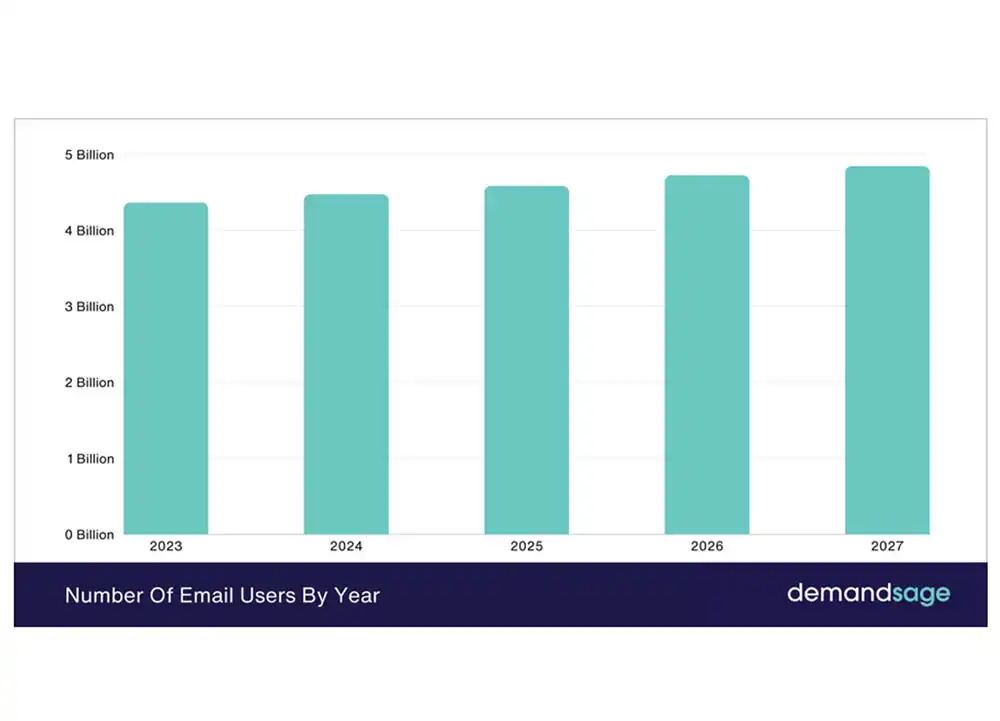
Source by https://www.demandsage.com/email-marketing-statistics/
Choosing the right platform to support such a massive business email infrastructure is a critical operational decision.
The wrong choice can disrupt client communications, inflate operational costs, and place an excessive workload on the IT team.
Lessons from the Field: The "Email as a Formality" Phenomenon and the Risks of Shadow IT
As an IT Infrastructure & Operations Professional, I frequently encounter an interesting anomaly while working with clients across different industries.
Despite the massive global email usage statistics above, many companies—even relatively large organizations—provide only one to five official corporate email accounts, often limited to addresses such as info@, sales@, or finance@.
So what happens to everyone else? In their daily work routines, employees are often forced to use free personal email accounts such as @gmail.com or @yahoo.com to communicate with clients and vendors.
From a Digital Operations perspective, this is a major red flag. The practice introduces several serious operational risks:
Shadow IT & Data Leakage
The company has no control over data stored in employees' personal email accounts. If an employee resigns or is terminated, their entire communication history, important documents, and valuable client contacts may leave with them in their personal inbox.
For professionals, daily email communication represents a critical work record, with the average professional receiving up to 121 emails per day.
Damaged Business Credibility
Research shows that 80% of business professionals agree that professional email is a primary channel for customer retention.
Imagine a client receiving a high-value quotation from an address such as andisales123@gmail.com. The risk of the message being perceived as fraudulent is significantly higher.
Greater Exposure to Security Threats
Free personal email accounts do not provide the same enterprise-grade security controls that can be centrally managed by a company's IT administrator, making them more vulnerable to attacks such as phishing.
Business email infrastructure should be consistently deployed across all levels of operational staff.
To help determine the right platform, let's break down an objective comparison between three major approaches: a Self-Hosted Email Server, Google Workspace, and Zoho Mail.
DigOps Parameter Comparison Matrix
| Operational Parameter | Self-Hosted Email Server | Google Workspace | Zoho Mail |
|---|---|---|---|
| Data Sovereignty & Privacy | 100% of the data remains on your own server. | Data is subject to the service provider's policies and regulations. | Data is subject to the service provider's policies and regulations. |
| Vendor Lock-in | Freedom to move to another backend at any time with minimal restrictions. | Leaving the ecosystem can be difficult once teams become heavily dependent on it. | Can become relatively restrictive when combined with other Zoho applications. |
| Deliverability | New IP addresses are vulnerable to spam filtering without proper expert configuration. | Uses the provider's established global IP reputation. | Maintains a clean and solid email-sending IP reputation. |
| Cost Efficiency at Scale | Highly cost-efficient. Server costs remain relatively fixed regardless of the number of accounts. | Expensive at scale. Pricing is calculated per user every month. | Uses a per-user pricing model but offers a more affordable entry-level cost. |
So, Should You Choose Cloud Email or Run Your Own Server?
Every approach has its advantages and disadvantages. Each IT professional has different experiences, which naturally influence both objective and subjective assessments. However, from a Digital Operations perspective, the overall landscape can still be mapped out clearly.
1. Self-Hosted Email Server
This approach involves renting a VPS or physical server and independently configuring email software such as Postfix, Dovecot, or Zimbra.
Operational Advantages: The company maintains full control over data privacy. No external service provider controls the email infrastructure. This option can also be highly economical when used primarily as application infrastructure, such as for an e-commerce system that needs to send millions of automated notification emails every day.
Operational Disadvantages: It can place a significant burden on the internal IT team. You are responsible for security, backups, storage quotas, and the risk of your IP address being blacklisted and causing outgoing emails to land in recipients' spam folders. If the server goes down, business communication can come to a complete halt.
2. Google Workspace
An all-in-one cloud-based collaboration platform built around Gmail as its core email service.
Operational Advantages: It offers near-100% uptime and one of the strongest global email-sending reputations. Operational friction is minimal because Gmail, Drive, Docs, and Sheets are seamlessly integrated for real-time collaboration. Your IT team is also freed from the technical burden of maintaining email servers.
Operational Disadvantages: Its per-user/month pricing model makes it the most expensive option of the three at scale. If your company employs hundreds of staff members, the annual subscription cost can become substantial.
3. Zoho Mail
A fully managed professional business email service focused on privacy, security, and cost efficiency.
Operational Advantages: It offers a strong balance between cloud reliability and budget efficiency. Zoho reduces unnecessary operational costs without sacrificing security. Integration is particularly strong when your Digital Operations also rely on other products in the Zoho ecosystem, such as Zoho CRM or Zoho Desk. This makes it a practical solution for migrating employees away from free personal email accounts without creating excessive operational expenses.
Operational Disadvantages: Its document productivity ecosystem is not as widely adopted as those of its main competitors, which means new employees may require some additional time to adapt to the platform.
Choosing the Right Email Infrastructure for Your Business Scale
There is no single solution that works best for every situation. The right choice depends on your operational scale and the primary bottlenecks your business is currently facing:
Choose a Self-Hosted Server if: Your company operates in an industry with strict privacy regulations, such as Fintech, Banking, Government, or Legal Services, where data must remain on internally controlled servers. This option is also suitable for high-volume transactional email requirements, provided that you have a dedicated DevOps or IT team capable of managing the infrastructure.
Choose Zoho Mail if: Your business is an SME, bootstrapped startup, agency, or retail company looking to move away from free personal email accounts and adopt professional business email without dealing with server maintenance, while still operating under strict budget constraints.
Choose Google Workspace if: Your company is a multinational corporation, creative agency, or large startup that prioritizes fast, cross-department document collaboration above everything else and has a flexible operational budget to improve employee productivity.
Manage Your Business Email Infrastructure with the Right Expertise
Choosing the right email architecture is not simply about finding the cheapest subscription plan. It is about maintaining a high delivery rate, preserving data sovereignty, and reducing operational downtime as close to zero as possible.
Within the Digital Operations ecosystem, email is more than a tool for everyday communication. It is the heart of business communication, the identity behind your corporate domain, and a gateway for notification systems and system integrations.
As an organization grows, Digital Operations teams often face an infrastructure dilemma: Should the company build and manage its own Self-Hosted Email Server, or move to a Managed Email service such as Google Workspace or Zoho Mail?
CONCLUSION:
From a Digital Operations perspective, the highest level of efficiency is achieved when a company can focus its resources on its core business rather than spending unnecessary energy maintaining basic infrastructure.
Allowing employees to use personal email accounts for business purposes is not a cost-saving strategy; it is simply accumulating operational risk for the future. Reevaluate your IT team's resources, calculate the Total Cost of Ownership (TCO), and build a secure communication system that protects your business assets.
Contact me if you are looking for support with IT architecture and Digital Operations optimization for your business.